

The 2028 Republican Primary A Demographic Deep Dive

Vance Leads a Fractured Field, but the Coalition That Wins May Not Be His
WASHINGTON, DC, UNITED STATES, February 6, 2026 /EINPresswire.com/ -- A new survey of Republican and Independent voters reveals that while Vice President J.D. Vance enters the 2028 Republican primary as the clear frontrunner, the race is far from settled.Vance: Strong, but Narrow
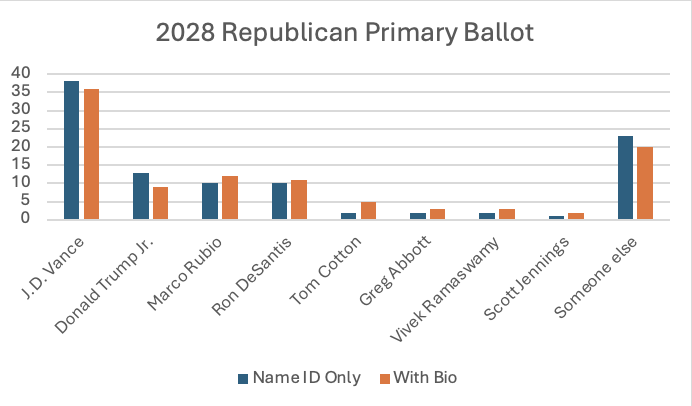
Vice President Vance leads the field with 38% support, driven largely by older, white, self-identified Republicans—the party’s traditional base.
Vance’s most significant vulnerability is with Independents. Among this group, 46% choose “someone else,” the single largest response. Vance earns just 19%, only marginally ahead of Senator Marco Rubio at 12%.
Minority Voters: An Open Contest
• Black Republicans and Independents: Donald Trump Jr. leads with 23%, followed by Vance at 14% and Rubio at 12%. Vance’s dominance elsewhere does not translate to this group.
• Latino Republicans and Independents: Vance and Trump Jr. are tied at 24%. Governor Ron DeSantis lags significantly at 9%, while Trump Jr.’s combination of youth appeal and Latino support represents a distinctive coalition.
The Youth Vote: Trump Jr.’s Lane
Among voters ages 18–34, Vance still leads at 35%, but Trump Jr. posts a strong 18%, narrowing the gap compared to the overall electorate. DeSantis again struggles with just 9%. By contrast, Vance is strongest among voters 65 and older, where he leads with 39%.
Gender and Education Divides
Women are more likely to be undecided, with 26% selecting “someone else,” compared to 20% of men. Vance’s base skews slightly female (40% women vs. 36 % men), while Rubio’s support skews male.
Education differences are modest but revealing. Vance performs slightly better among non-college voters (40%) than college-educated voters (36%). More importantly, college-educated Republicans are more likely to choose “someone else” (25%), signaling unmet demand among educated voters.
The Jennings Factor
CNN Senior Political Commentator Scott Jennings, included as a test case, registers 1% on a name-recognition-only ballot. After voters receive biographical information, his support doubles to 2%.
While still small, the movement is notable. Jennings’s profile—media-tested, combative, and unafraid of hostile territory—is unlike any other figure in the field. His 6% support among voters 18–34 on the bio-informed ballot suggests potential appeal with younger Republicans who engage politics through digital and viral media.
Historically, several eventual nominees began in low single digits two years before primary voting. Jennings’s data raise a central question: can communication skill and message discipline substitute for traditional political credentials in an unsettled field?
The 2028 Republican primary will hinge on three questions:
1. Can Vance expand beyond his core base, or does his Independent weakness create a decisive opening?
2. Which candidate consolidates the growing minority Republican vote?
3. Is the 23 % “someone else” electorate waiting for an existing candidate to break out—or for a new entrant with a different profile altogether?
With two years until primary voting begins, the race remains wide open.
Read the full poll results and cross tabs here.
Chuck Warren
Rainey Center
+1 702-343-5774
chuck@septembergroupllc.com
Visit us on social media:
LinkedIn
Instagram
Facebook
X
Legal Disclaimer:
EIN Presswire provides this news content "as is" without warranty of any kind. We do not accept any responsibility or liability for the accuracy, content, images, videos, licenses, completeness, legality, or reliability of the information contained in this article. If you have any complaints or copyright issues related to this article, kindly contact the author above.
